Containerised deployment
Docker and Compose setups that run the same way on your laptop, staging and production — ending the class of bug that starts "works on mine".
Containerised deployments, CI/CD, database tuning, backups and monitoring — so shipping is routine and outages are short.
A surprising number of small companies are one failed hard drive away from losing their business, and do not know it. Backups that were never restored, a server somebody set up in 2019 and left, deploys that happen over SSH at midnight.
This work is mostly unglamorous and enormously valuable: make deployment repeatable, make failure visible, make recovery tested. I do it as a one-off hardening engagement or as ongoing infrastructure ownership.
Docker and Compose setups that run the same way on your laptop, staging and production — ending the class of bug that starts "works on mine".
Push to main, tests run, build happens, deploy goes out. GitHub Actions or GitLab CI, with a rollback that takes a minute rather than an afternoon.
Nginx, Gunicorn or uvicorn, TLS with automatic renewal, systemd services, log rotation and sane resource limits.
Slow-query analysis, indexing, connection pooling with PgBouncer and caching layers — usually cheaper than the bigger instance you were quoted.
Automated off-site backups with a restore that has actually been performed. An untested backup is not a backup.
Uptime and error alerting that reaches a human, plus a security pass: headers, secrets management, patching, firewall and least-privilege access.
A working session to pin down what the system has to do, who touches it and what already exists. You get a written scope, an architecture sketch and a realistic estimate before anything is committed to.
Data model, API surface and screens, agreed before the build. Designing against real data and real edge cases is what stops the rebuild three weeks in.
Working software every week against a staging URL you can open, rather than a big reveal at the end. Feedback lands while it is still cheap to act on.
Deployment, DNS and TLS, database migration, backups, monitoring and an handover walkthrough. The system goes live on infrastructure you own.
Optional retainer: security patches, feature work, performance passes and a person who already knows the codebase when something breaks.
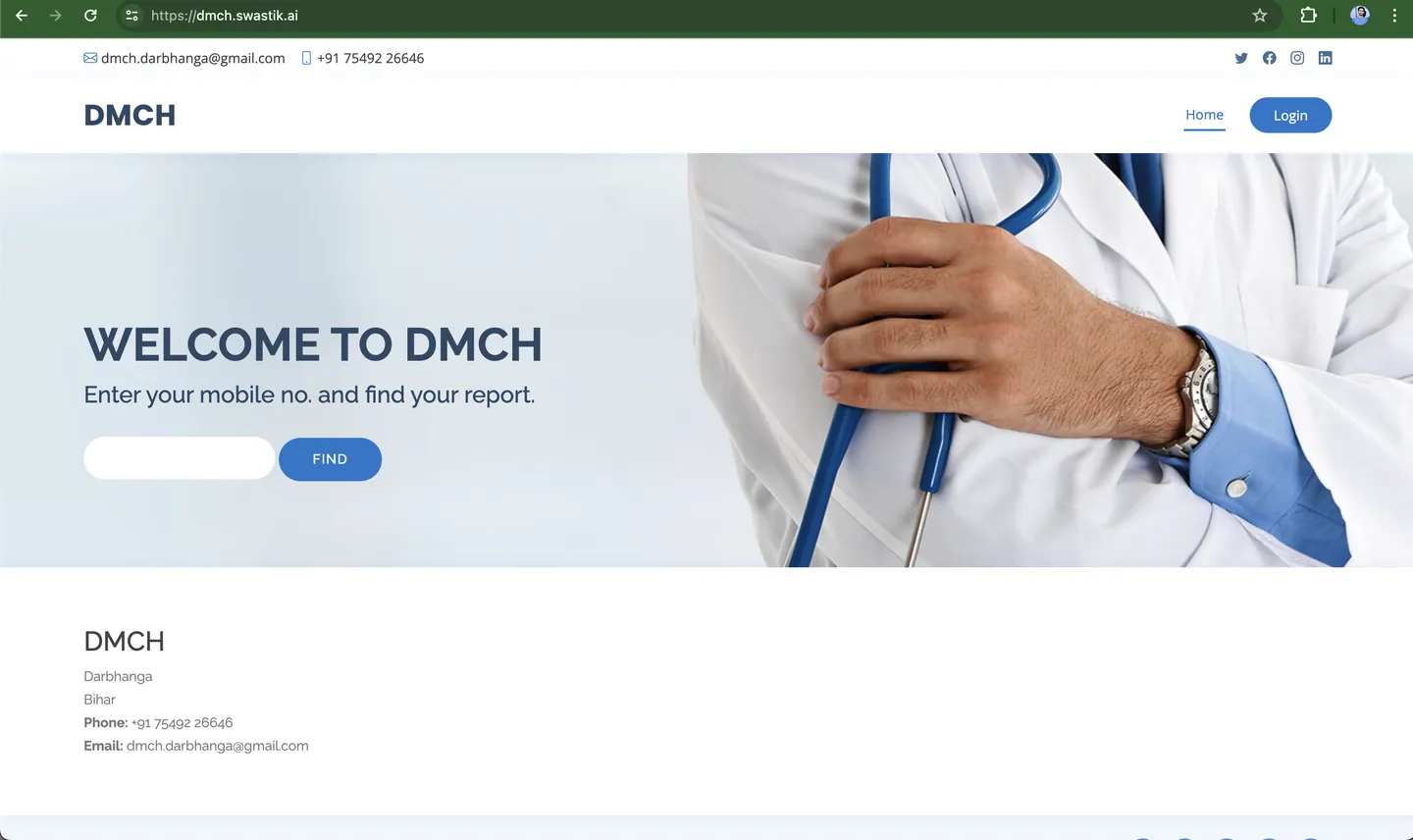
An end-to-end hospital management system covering patient registration, OPD and IPD workflows, billing, pharmacy, pathology, radiology, blood bank and medical records — running in production on a government medical college campus.
Read the case studyYes — that is a common starting point. It begins with an audit: what is actually running, what is logged, what is monitored. Usually the fix is unglamorous (a missing index, an unbounded queue, a full disk) and cheap once it is visible.
Honestly, most small and mid-size applications run happily on a well-configured VPS for a fraction of hyperscaler pricing. I recommend AWS or Azure when you genuinely need managed services, multi-region or a compliance story.
Yes. Documenting what exists is the first deliverable — a surprising number of handovers are the first time anyone has written it down.
Monthly retainers cover patching, monitoring, backup verification, performance passes and incident response, with a defined response time.
Tell me what you are trying to ship. You get an approach, a timeline and a realistic estimate — usually within a working day.